POTS: A Clinical Deep Dive
Why postural orthostatic tachycardia syndrome is the most consistently missed diagnosis in complex chronic illness and why nothing else resolves until it is addressed.

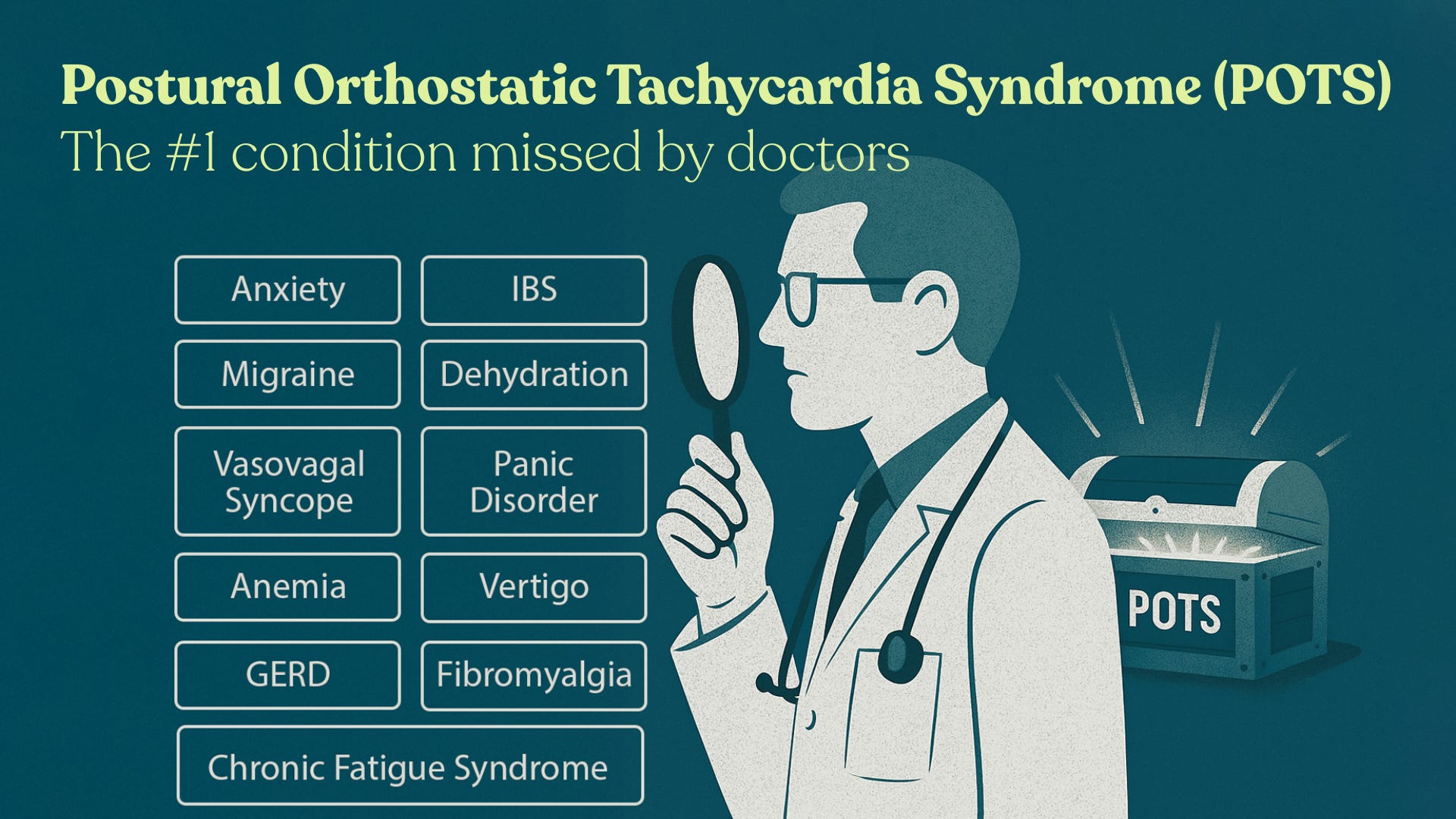
Postural Orthostatic Tachycardia Syndrome (POTS) is a complex condition that can drastically affect the day-to-day lives of those that suffer from it. It is a type of orthostatic intolerance, which means that it gets worse when people who have the condition are standing, or when they move from a lying or sitting position to a standing position.
POTS isn’t a rare condition but often isn’t considered, understood, or accurately diagnosed by primary healthcare providers. Most doctors don’t routinely think about it or test for the condition in their offices. A missed diagnosis of POTS (as well as that of orthostatic hypotension) can have devastating consequences for an individual’s health issues and prospects of recovery. In fact, my experience is that without recognition and adequate treatment of this condition, very little can be achieved regarding recovery for those suffering from complex, chronic health issues, where POTS is frequently a dominant co-morbid condition that’s notoriously underdiagnosed. This condition is often accompanied by a high degree of functional disability, appearing under the radar and masquerading as many other health conditions, most commonly referred to as psychosomatic, a cruel diagnosis to assign to a person that has very real biological and physiological imbalances.
In this two-part series, I’ll be discussing the etiology of POTS, how it manifests in most people, the common comorbid conditions it’s often seen with, and how to diagnose and treat the condition.
In this first part you’ll learn:
What POTS is, including the full spectrum of signs, symptoms, and complications
The four distinct subtypes of POTS and why each one reflects a different underlying mechanism, a different clinical picture, and a different treatment target
How to distinguish POTS from orthostatic hypotension and sinus tachycardia syndrome, which share overlapping presentations but have different physiological drivers and are frequently confused in primary care
How POTS manifests alongside mast cell activation syndrome (MCAS), chronic fatigue syndrome, hypermobile Ehlers-Danlos syndrome, fibromyalgia, and the broader triad and pentad of conditions that Dr. Andrew Maxwell has mapped
What we currently understand about the causes of POTS and why the pathophysiology in many patients remains incompletely defined
The full diagnostic criteria, including the strict threshold requirements for heart rate rise, the conditions that must be excluded before a diagnosis is made, the standing test protocol, and the tilt-table test as the gold standard for confirmation
The gastrointestinal dimension that almost no one discusses: Moak and colleagues demonstrated that even among POTS patients with entirely normal baseline gastric motility studies, sixty-eight percent became abnormal during tilt-table testing, a finding that fundamentally reframes what we have been calling functional GI symptoms in this population
In my 40+ years of working with patients whose illnesses have defeated every previous attempt at treatment, I have come to regard the failure to identify and treat POTS early as the single most common reason that complex chronic illness does not resolve. This article will show you exactly why and what to do about it.
